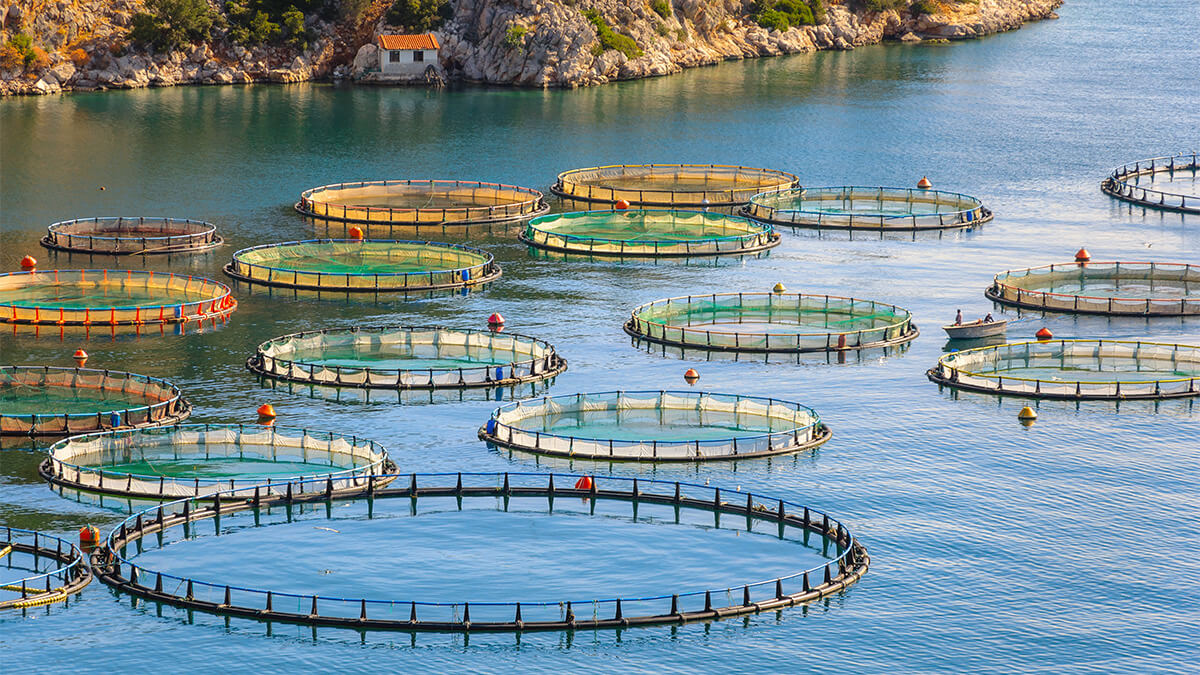

Why retrofitting aging lighting infrastructure demands a systems-level approach on modern farms
Offshore aquaculture farms operate in some of the most demanding maritime environments on earth, and the lighting infrastructure that marks their perimeters, cages, and working areas bears the full weight of that reality. Over time, that infrastructure ages. Flash characters drift out of synchronisation, battery capacity degrades, and lanterns that once met IALA requirements no longer deliver consistent visibility. When that happens, the instinct is often to replace individual units on a like-for-like basis. It is an understandable response, but it is rarely the right one.
This article explains why retrofitting aquaculture lighting infrastructure demands more than a component-by-component swap, and how a systems-level approach produces outcomes that are safer, more compliant, and more cost-effective over the long term. Each section builds on the one before it, moving from the definition of what retrofitting actually involves on a working offshore farm, through the failure dynamics of aging systems, to practical frameworks for specifying and executing a retrofit that serves the farm for years to come.
What retrofitting lighting infrastructure actually means on offshore farms
Retrofitting aquaculture lighting means replacing or upgrading existing marine lanterns, power sources, and control systems on an operational offshore installation without rebuilding the physical infrastructure that supports them. It is distinct from a new installation, where every element is specified from scratch, and distinct from routine maintenance, where individual failed components are swapped back to their original specification.
On a working offshore fish farm, retrofitting typically involves a combination of hardware replacement, power system changes, and reconfiguration of flash characters and synchronisation settings to meet current IALA requirements. The physical environment constrains every decision: mounting points are fixed, cable runs are established, and the farm continues operating throughout the process. This is not a clean-sheet engineering exercise.
The distinction matters because it shapes the entire decision framework. For example, replacing a single alkaline-battery lantern with a solar-powered unit changes not just the light source but the power budget, the maintenance schedule, and potentially the regulatory status of that marking position. A retrofit that treats each lantern as an isolated unit will miss those interdependencies entirely. Understanding this is the foundation on which every subsequent decision in a systems-level approach rests.
Why aging lighting systems fail in ways that compound each other
Aging offshore fish farm lighting does not fail uniformly. Individual components degrade at different rates, and the failures interact in ways that create cumulative risk greater than the sum of the individual faults. This compounding dynamic is the core reason why a piecemeal response to aging infrastructure consistently underperforms.
Consider a typical failure sequence. A battery pack reaches the end of its service life and the lantern begins operating at reduced intensity during the final hours before dawn. At the same time, a neighbouring unit loses GNSS synchronisation and its flash character falls out of phase with the rest of the farm perimeter. Neither failure is immediately visible during a routine inspection conducted in daylight. Together, they create a section of perimeter that is both dimmer than specified and flashing in an irregular pattern that a vessel crew cannot reliably interpret.
The compounding effect extends to compliance. IALA-compliant aquaculture lighting requires consistent intensity, correct colour, and synchronised flash characters across the entire installation. When individual units degrade independently, the farm as a whole may fall out of compliance even if each individual lantern, assessed in isolation, appears functional. The following failure modes are the most common drivers of this dynamic on aging installations:
- Battery capacity degradation reducing effective operating hours, particularly in winter months with limited solar recharge
- UV-induced lens yellowing altering the chromaticity of the emitted light and reducing effective range
- Loss of GNSS synchronisation causing flash character desynchronisation across the perimeter
- Mounting corrosion changing the vertical divergence angle of the lantern and reducing its visibility from low-freeboard vessels
- Firmware version mismatches between units installed at different times, preventing consistent programming via a single control interface
Each of these failures is manageable in isolation. Together, they represent a system that is no longer performing as designed, and that requires a system-level diagnosis before any meaningful remediation is possible.
How a systems-level approach changes the retrofit decision process
A systems-level approach to retrofitting aquaculture lighting begins with a whole-farm audit rather than an inspection of individual units. The central question shifts from “which lanterns need replacing?” to “what is the current performance of this installation as a navigational marking system, and where does it fall short of what the farm requires?”
This reframing changes what gets measured. A component-level inspection checks whether each lantern is illuminated and producing visible output. A systems-level audit assesses synchronisation across the entire perimeter, verifies that intensity and flash characters meet current IALA requirements at every marking position, evaluates the consistency of power supply across all units, and maps the relationship between the current lighting layout and the actual boundaries of the farm, including any recent cage additions or structural changes.
The practical consequence is that the retrofit specification that emerges from a systems-level audit will often look quite different from what a unit-by-unit inspection would recommend. It may identify that lanterns which appear functional are operating below specification, that the farm layout has evolved since the original installation in ways that leave certain approach vectors inadequately marked, or that a mixed inventory of products from different generations creates programming and monitoring incompatibilities that cannot be resolved without standardisation.
The audit as a compliance baseline
A systems-level audit also establishes a documented compliance baseline, which serves a purpose beyond the retrofit project itself. Maritime authorities and aquaculture licensing bodies increasingly require operators to demonstrate that their marking systems meet current standards, not merely that individual lanterns are operational. A documented audit creates the evidence trail that supports that demonstration.
Power system assessment as a non-negotiable audit component
Power system assessment deserves particular attention within the systems audit. Solar-powered lanterns on offshore farms are subject to shading from cage superstructures, salt accumulation on panels, and seasonal variation in solar irradiance that can reduce effective charging capacity significantly. An audit that does not include a power system assessment will miss the root cause of many intensity and operating-hours failures, and a retrofit that replaces lanterns without addressing the underlying power constraints will reproduce the same failures within a shorter timeframe.
Applying the systems audit to a real offshore farm layout
To make the systems audit concrete, consider a representative offshore farm layout: a grid of twelve cages arranged in three rows of four, with a service pontoon on the eastern side and mooring buoys marking the outer perimeter at eight positions. The installation was originally commissioned eight years ago and has been extended twice, with four additional cages added on the western boundary three years after the original installation.
A systems-level audit of this farm would begin by mapping every current marking position against the actual farm boundary, including the western extension. It would immediately identify that the western perimeter additions were marked using lanterns from a different product generation than the original installation, with a different flash character programming interface and a different battery chemistry. Those units cannot be synchronised with the original perimeter lanterns through a single programming session, which means the farm has been operating with two independently timed flash sequences on a single perimeter.
The audit would then assess each marking position against the following criteria:
- Does the lantern meet current IALA intensity requirements for its designated range and colour?
- Is the flash character correctly programmed and synchronised with the rest of the perimeter?
- Is the power system delivering consistent performance across the full operating cycle, including the lowest-insolation period of the year?
- Is the mounting position and vertical divergence angle appropriate for the vessel traffic approaching that section of the farm?
- Does the lantern provide radar detection capability at positions where vessel approach risk is highest?
This structured assessment produces a prioritised list of interventions that addresses the most significant safety and compliance gaps first, rather than simply replacing the oldest units. In the example above, the synchronisation failure on the western perimeter would be the highest priority, regardless of the physical condition of the individual lanterns involved.
Common retrofit mistakes that create new compliance and safety risks
Even with a systems-level audit in place, retrofit projects can introduce new risks if the specification and execution phases are not managed carefully. Understanding the most common mistakes is the final layer of conceptual preparation before moving to specification.
The first and most consequential mistake is mixing product generations without verifying programming and synchronisation compatibility. Offshore fish farm lighting retrofits are rarely executed in a single campaign. Budget constraints, operational windows, and supply lead times mean that new lanterns are often added to an installation that still includes units from a previous generation. If those generations use different programming interfaces or different GNSS synchronisation protocols, the result is a perimeter that cannot be managed as a unified system.
The second common mistake is specifying replacement lanterns based solely on the intensity and range of the units being replaced, without reassessing whether the original specification still reflects the farm’s current layout and the vessel traffic environment around it. A farm that has expanded since its original installation may have marking positions that now require greater range or different flash characters to adequately protect the new boundary.
The third mistake is treating compliance as a point-in-time achievement rather than an ongoing operational requirement. A retrofit that brings the installation into compliance at the moment of commissioning but does not include a monitoring capability to detect subsequent degradation will require another full audit within a few years. Remote monitoring capability, where available, converts compliance from a periodic inspection exercise into a continuous operational status.
A fourth mistake, less obvious but equally damaging, is failing to document the post-retrofit configuration. When a farm changes hands, when a new maintenance contractor takes over, or when a regulatory inspection requires evidence of compliance, an undocumented installation creates significant operational and legal exposure.
Build a retrofit specification that accounts for future farm expansion
A retrofit specification that only addresses the farm’s current state is a specification that will need to be revisited the next time the farm expands. Building future expansion into the specification from the outset is not speculative planning; it is a direct application of the systems-level principles established earlier in this article.
The starting point is product standardisation. Specifying a single product family across the entire installation, rather than selecting the optimal unit for each individual position, creates a platform that can be extended consistently as the farm grows. When all lanterns share a common programming interface, a common synchronisation protocol, and compatible battery and power systems, adding new marking positions to a farm expansion requires only configuration work, not a new integration exercise.
Products such as the Sabik SBFL 160 Marker Light, designed specifically for aquaculture farm marking with integrated radar reflection, GNSS synchronisation, and Bluetooth programming via the Sabik Easy Programmer, illustrate what platform standardisation enables in practice. When the same product family is deployed across a perimeter, every new unit added during a farm expansion is immediately compatible with the existing synchronisation and monitoring configuration.
The specification should also address monitoring architecture. A farm that deploys aquaculture lighting with remote monitoring capability from the outset can scale that monitoring to cover new marking positions without architectural changes. The LightGuard Monitor, which provides web-based access to real-time lantern status data, including battery levels and operational hours, is designed to accommodate additional units within an existing monitoring framework. This means that a farm expansion does not require a new monitoring deployment; it requires only the addition of new units to an existing monitored network.
Finally, the specification should include a configuration record that documents every programmed parameter for every marking position: flash character, intensity setting, synchronisation source, and mounting orientation. This record serves as the baseline for future audits, the reference for maintenance contractors, and the evidence base for regulatory compliance demonstrations. It is the document that transforms a retrofit from a one-time project into the foundation of a managed, long-service-life lighting infrastructure.
Retrofitting aging aquaculture lighting infrastructure is not a maintenance task. It is an engineering decision with direct consequences for vessel safety, regulatory compliance, and the long-term operational cost of the farm. A systems-level approach, grounded in a whole-farm audit and executed with a specification that accounts for future growth, is the only approach that reliably delivers on all three of those dimensions.
Contact Sabik’s technical team to discuss your aquaculture lighting retrofit requirements.